TOUGH ENOUGH
The propellers throbbed as the turbo-prop circled and landed on Cold Bay’s huge runway three hours west of Anchorage in early November as we arrived for our sea duck and brant hunt. The tiny town is on the last chunk of mainland peninsula before the Aleutian archipelago starts, and rich with bizarre military history here dating back to an attempted invasion by Japan in WW II (hence the big runway).

Raw and beautiful, it also holds a record for the most overcast community in America and is famously difficult weather for pilots. Ours was a sunny and calm landing under blue skies, and that made it hard to imagine what would greet us in the morning, just 12 hours later, in this place where North Pacific storms trade across into the Bering Sea in the waters featured on “Deadliest Catch.” It is a raw land of burning cold winds and steaming volcanoes puffing in the distance that at times throw red magma into the night. The area is crawling with giant brown bears, and thin jagged pinnacles loom like ice fortresses in the distance.
It’s a good place for something to be born, or at least born again. And very soon, it made perfect sense why Benelli had chosen this location to launch the third coming of the legendary Super Black Eagle. In the pre-dawn, winds were soon gusting to 70 mph, howling straight off the ocean and lashing at our windows, spewing sideways rain and slush. You could hear storm surf pounding as we awoke at “sunrise,” roughly 9:30 a.m. The group of hunters assumed we’d wait for it to calm, that no ducks could fly in that kind of weather.
But that’s not the Captain Jeff Wasley way. The lodge door burst open, and Wasley blew in with a gust and stood there, already soaked, with waterdrops flecked on his eyeglasses, and murmured “20 minutes and we roll out.” Ever more the bearded sea captain than mild-mannered biologist he also is, Wasley started Four Flyways Outfitters for his great love of ducks and hunting, and he is at the top of the food chain here and, well geographically, the world. Over the next five days we would break an outboard motor far from port, and stall a jacked-up suburban to the windows in the middle of a gushing river. But the one thing we couldn’t break were these guns.

Benelli’s Super Black Eagle landed in the early ‘90s and rose to prominence as the duck man’s broadsword over that decade. The gun set a new standard as one of the first semi-autos to handle 2 3/4”on up to 3.5” shells, when the longer shells were developed to help offset the inferior downrange lethality of steel after lead was banned.
Nobody had seen anything quite like the Black Eagle when it came out; the overall slenderness and the lovely between-the-hands balance, because most of the weight is in the receiver where the Inertia-Driven system hides. The shotgun quickly became a waterfowling status symbol and helped a young company that only started building guns in 1967 carve out a niche from a field dominated by centuries-old brands. The new SBE 3 has the same core guts as the original: That simple Inertia-Driven system, built around a powerful compact spring housed within the bolt that is the “engine” for the recoil operating system .
At least a dozen design and ergonomic touches elevate the SBE 3 model, aimed at lighter weight, better handling and shooter comfort, along with less recoil and muzzle rise. It is a super-refined version of the original: softer-kicking, user-friendly, and pure Italian with stylish accents by Marco Vignaroli on the receiver borrowed from the elegant Ethos model. The accent lines represent the silhouette of a bird in flight.
Another critical add for the SBE 3 is the new “easy locking” detent in the bolt assembly, which assures the rotating face always seats, even when the gun is bumped on the butt stock or the action is crudded up with residue. Other major tweaks include an improved (third generation) ComforTech stock to redirect recoil with an excellent larger, softer cheek pad for forgiveness.
Nobody is nastier to their guns than waterfowlers. We threw these guns in aluminum boats that pounded through waves, covered them in marine spray, let them bang around in the decoys and get stepped on by muddy dogs streaming saltwater, tossing them on the beach between sessions. And, of course, we shot hundreds of high-velocity, heavy duck loads through them, all in near-freezing conditions. The climate was so harsh, standard non-Benelli choke tubes were rusted by day two.
HEADING OUT
On that first morning of heavy storm winds, we expected Capt. Jeff to step forward and explain what we would do when the weather died. But you don’t work around the weather in Cold Bay, Alaska, you just try to survive it. The Cold Bay experience is one of pristine wilderness, and a bucket-list adventure for trophy species in wild spaces for core waterfowlers.
But it’s wilderness for a reason. We piled out of the trucks that first dawn, and stood nervously in the gale as we fought to close the vehicle doors in the wind, unsure of ourselves but grateful for all the high-tech Sitka clothing. Most of us tromped down to a nearby lake shore—ocean hunting was out of the question with giant surf—and hid not far from the road to hunt. But I had mentioned that I wanted a rare Eurasian teal or wigeon the night prior, and that earned me a brutal hike.
Wasley lined a few of us out on a cross-country jaunt in the torrent, dropping off two others at the halfway point. Hoofing around the rugged lakeshore, we waded over greasy boulders, and I had to use the butt stock of the new gun to catch myself a few times in the slick rocks, submerging it past the trigger group like a wading staff.
Three times, wind gusts grabbed the large metal frame pack full of decoys protruding from my back like a sail and nearly drove me into the lake. I quickly learned to hoof it bent doubled over.
It was strange to see the powerful winds lift the surface waters off a lake and vaporize them skyward in a reverse rainstorm. The tundra was horribly difficult hiking, like jogging in a ditch full of sponges, until you hit a trail; but here’s the problem with that. These nice trails were created by 1,000-pound brown bears, just as heavy-bodied as the famed Kodiak monsters.
Lunging over the spongy tundra, hitting a trail filled with water but grateful for the hard bottom, I stumbled along a full hour behind my guide and let me tell you, as we strolled past hundreds of half-eaten sockeye and piles of brown bear scat, it was awfully nice to have a reliable 12-gauge with 3-inch 1⅝-ounce Hevi-Shot loads riding on the carrier in my hand, just in case the Man in the Brown Suit showed up. One stroke of the bolt handle and we would be ready to try to defend ourselves.

We finally struck a tiny bay, hunkered beside a hummock, and threw out a few decoys. The fun started instantly with a pair of stunning drake goldeneyes buzzing through. The first was too fast but he left his wingman bobbing in the decoys. A matching drake bufflehead appeared next and a clean double on those beauties was followed by some of the biggest mallards on earth splashing feet up. All the birds were stunner fully-plumed drakes from the far north. Even while wearing arctic-worthy Sitka, this gun was easy to shoot.
Case in point. Hiking out, fighting the wind with five heavy ducks bouncing on my strap against my chest and a loaded pack on my back, we somehow heard the rush of wings and turned as a super-sized-mallard burst from the reeds 15 feet below the ledge we trudged along. In a flash I had the gun up, and despite the ducks around my neck, ripped back the bolt handle, turned and crushed that greenhead with one shot at 40 yards. Mallards here can be massive, over four pounds, because most do not migrate, and they gorge on salmon eggs and carcasses. Mark was delighted at the shot, though we had to wait a good bit for the wind to bring it ashore.

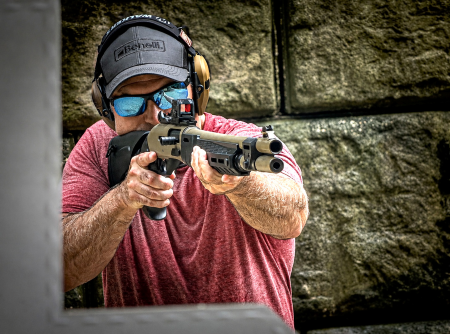
You can’t say much more than that about a shotgun’s handling. Or the oversized bolt handle on the SBE 3 when I’d needed to chamber that round, or the newer grip and trigger design I’d found with soaking thick gloves in a critical split second. The rounded trigger guard is forgiving, and the pistol grip is deeper, allowing more control to access the trigger. A deeper pistol grip reduces recoil by letting you more into the gun and giving more grip control, eliminating “punch.”
The fumbling cold and slippery wet climate was the ideal test for all the features added to the SBE 3 when it premiered, like that redesigned grip and bolt handle, as well as the newly slenderized and enhanced forestock, and especially the new enlarged loading port with big grooves in front of the new trigger guard to smooth feeding. A redesigned carrier/lifter also helps.
It was a grueling five-mile hike, all told, in the unrelenting wind over the squishy thick moss. The gun is a pleasure to carry, and lighter than its predecessors, right at 7 pounds. I was grateful for the firepower (bears) but also the lack of bulk and heft. The engineers said they could have made the gun almost a pound lighter, and wanted to, but the team at Benelli decided that might just be too light for a 12-gauge firing waterfowl loads.
Later, back home on the range, I threw my entire garage stash into the gun, feeding it everything from rusty old Black Cloud to new 3.5” high velocity B&P 1.5-ounce 2s. Buckshot, Hevi-Shot, slugs, 1-ounce dove loads…the gun ate them all.
There was a measured evenness in shot patterns. Pretty cool as a shotgunner to be able to feed a wild mix of loads and shell lengths into a gun and see it spit them all out like a wood chipper. Tungsten, lead, steel, didn’t matter.
ON TO THE BRANT
At times we would be feeding whatever shells we could grab into the SBE 3 on the frantic hunts for those stunning saltwater geese, the Pacific black brant, the absolute highlight of the Cold Bay trip. Brant from three flyways converge on the giant Izembek Lagoon to gorge on eel grass before migration, the highest concentration of the birds in the world.

Jumping in the layout boats 20 feet apart in the wind and waves, my partner Jeff and I were barely settled in when gobs of the saltwater geese came in low and straight. I doubled right away, and laid the Benelli down and focused on calling for Jeff, who quickly caught up. A single came high and right, then centered up the middle as I called. He was right in my wheelhouse, and at 20 he lifted left and I yelled “shoot him Jeff!” into the wind. Jeff popped up and missed, then cracked him hard. The retrieve boat yelled out “double-banded” when picking the bird up and we shout with joy, as Jeff scored the bird hunting trophy of a lifetime.
For three days, the brant hunting held just as strong, with so much action we rotated through the layout boats and even the guides took turns. We started calling ourselves the Hecklers, because there was always a half-dozen guys on the beach, watching the layouts just offshore, helping call in birds and cheering the shooters’ hits and especially their misses.
It was like a surreal dream come true for brant fanatics. The fact that everyone pounded out limits of these saltwater geese and nobody had trouble using an unfamiliar gun says an awful lot about the design.
It was a pure Alaska experience—eagles kept stealing our birds—and the brant are exquisite on the plate, some of the best wild game ever. When Wasley grilled those breasts, we all wondered how it was that brant were not extinct. On par with elk tenderloin, nothing like any waterfowl we’d eaten.

SEA DUCKS!
Brant die easy, but not sea ducks. Chasing them the last day, we were running the heaviest Hevi-Shot loads available, trying to kill the biggest duck in North America, the ghost-like Pacific eider. It was tough hunting, and few came close to limits but we all took home birds for the wall. On the bigger water in the bouncing layouts, these zipping sea ducks were some of the hardest birds to hit, the water rough enough I missed twice trying to finish off a cripple and laughed aloud—I’d missed a sitting duck!
Humbling, after making hero shots from Canada to Louisiana all season. I made up for it by doubling on drake harlequin, one of the prettiest birds on earth, managing to miss the hen flying between them.

Freezing saltwater aside, a layout boat is a perfect gun test because it is a lousy place to shoot from. Essentially a super-low kayak, you can’t shoot far to the right or left nor easily straight up, and the whole thing is moving in the waves.
The group of hunters agreed the SBE 3 is the softest-kicking Super Black Eagle ever, by far, and that the trademark system of rubber chevrons in the redesigned third generation ComforTech stock seem to reduce muzzle lift, and combine with the super-soft, oversized cheek piece (which houses its own flexible shim) to soften the feel of shooting.

That cheek piece is a savior, as the gun simply can’t punch you in the face anymore if you pull up a hasty mount and lack a good cheek weld. That is normally where you pay. The Black Eagle series was already a wingshooter’s dream and the last hunting shotgun you’ll ever need to purchase. This gun assures that legacy will prosper.
And this would prove to be only the beginning of my adventures with Captain Wasley.